
Explosion-Proof Conduit Fittings
Conduit fittings and accessories that complete a classified-area wiring system: cable glands, sealing fittings, couplings, adapters, breathers and drains.
Explosion-Proof Conduit Fittings — product range
Cable glands and fittings that complete a classified-area wiring system — protection types Ex d and Ex e, IP66, ambient −40 to +80 °C, threads in NPT, G and metric, in nickel-plated brass, stainless steel 316L and aluminium.
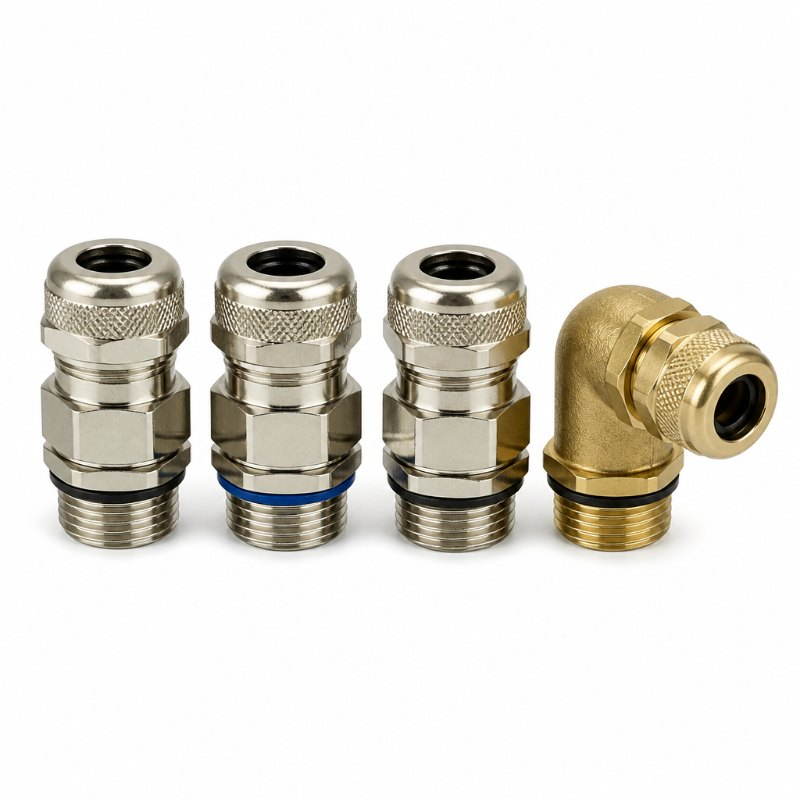
Other sizes, materials and thread standards are available to order. Tell us the cable outside diameter and thread standard and we will confirm the fitting.
Request a quote
Send the zone, cable outside diameter, thread standard and quantity for an indicative specification.
The fittings decide whether the enclosure keeps its rating
A certified enclosure is only certified in the condition it was tested in. Open one entry and close it with the wrong gland, and the rating on the label no longer describes what is installed. That is why conduit fittings and cable glands are not accessories in a hazardous-area project: they are the boundary between the protected interior and the classified atmosphere outside, and they are assessed as part of the assembly.
Selecting a cable gland
- Cable construction. Armoured, braided, screened or plain — the gland has to suit both the cable type and the way its screen or armour is to be terminated.
- Outside diameter. The gland is sized to the actual cable outside diameter, not to the nominal size of the cable. Measure the cable, or send the cable datasheet.
- Thread. The gland thread has to match the enclosure entry, in the same standard for the whole project.
- Protection concept. Glands are supplied in Ex d and Ex e versions; the concept has to match the enclosure they are fitted to.
- Material. Nickel-plated brass as standard, stainless steel 316L where corrosion or wash-down drives the decision, aluminium where weight matters.
The range covers −40 to +80 °C and IP66, with threads in NPT, G and metric, so that one project can be supplied consistently regardless of which thread standard the drawings call for.
Sealing fittings and compound barriers
Gas can travel along the inside of a conduit run between areas, so a classified-area wiring system is separated where it crosses a boundary. Sealing fittings and compound barriers exist for that purpose: they stop the passage of gas through the conduit, and they keep a fault in one area from reaching another. They are usually specified at the point where a run leaves a hazardous area, and their position belongs on the installation drawing rather than being decided on site.
Adapters, reducers and the thread question
Metric (ISO 965), G (ISO 228) and NPT (ASME B1.20.1) threads are all available. Metric and G threads are parallel and seal on a face or a washer; NPT is tapered and seals on the threads themselves, which is why the sealing method differs at the joint. Adapters and reducers make conversion possible, but each conversion adds a joint that has to be certified, correctly tightened and checked — so the cheapest answer is almost always to standardise the thread at the drawing stage and keep glands, fittings, breathers and stopping plugs on the same standard.
Breathers and drains
Sealed enclosures still breathe. Temperature cycling draws moisture in and pushes it out again, and the condensate that results is a common cause of insulation faults and corroded terminals, particularly in humid or coastal plants. Breathers and drains are fitted to let the enclosure equalise pressure without letting the classified atmosphere in, and they are part of the certified assembly for the same reason every other entry is.
Frequently asked questions
Do I have to use the same brand of gland as the enclosure?
The requirement is that the combination is suitable for the zone and assessed as part of the assembly. Ordering them together is the simplest way to keep that argument intact and to have one set of drawings.
How do I know which gland size to order?
From the cable outside diameter and the entry thread. Send both and we will confirm the fitting — for example the cable type, its outside diameter and the thread standard on the enclosure.
Are brass glands suitable outdoors?
Nickel-plated brass is widely used outdoors and in coastal areas, and stainless steel 316L is specified where the exposure or the wash-down regime is aggressive. The choice follows the environment, not the price.
Can threads be converted on site?
With certified adapters or reducers, yes. Every conversion is an additional joint, so it is worth checking whether a fitting in the correct thread can be supplied instead.
Do unused enclosure entries need anything?
Yes — certified stopping plugs or blanking plugs. An open or bolt-sealed entry is a finding, and on a flameproof enclosure it also affects the way internal pressure is contained.
What to send us for a quote
- Cable type and outside diameter for each gland
- Thread standard of the enclosure entries
- Protection concept (Ex d or Ex e) and the zone
- Material preference and any corrosion requirement
- Item list with quantities, including breathers, drains and stopping plugs
Request a quote with the cable outside diameter and thread standard and we will confirm the fitting.
Our factory videos show how explosion-proof flexible conduit is braided, jacketed and fitted before shipment.
Explosion-Proof Conduit Fittings: Frequently Asked Questions
Materials, thread standards and how to keep an Ex installation compliant after assembly.
Which materials are available for conduit fittings?
Galvanized carbon steel for general industrial and outdoor runs, nickel-plated brass for cable glands and small fittings where corrosion resistance and tight tolerances matter, cast steel for heavier unions and couplings, and 304 or 316 stainless steel for offshore, coastal and chemical duty. The material is selected against the corrosive class of the environment rather than the price, because a corroded fitting breaks both the IP rating and the Ex integrity.
What is the difference between a cable gland and a conduit fitting?
A cable gland grips and seals the cable where it enters an enclosure, and in flameproof Ex d designs it also provides the barrier that prevents flame from passing along the cable; larger Ex d glands are filled with sealing compound. A conduit fitting joins conduit to an enclosure or to another length of conduit and does not seal a cable. Explosion-proof installations usually need both, chosen to match the protection concept of the equipment.
Which thread standards and sizes do you supply?
Metric from M16 to M75, PG from PG9 to PG48, and NPT from 1/2 inch to 3 inch. Straight and 45°/90° elbow versions, couplings, reducers and adapters let you connect to enclosures that were drilled to a different standard, and we confirm the thread pitch before production so the fitting seats correctly.
How do I keep the Ex and IP rating after installation?
Four points decide it: use an entry that matches the equipment marking, fit the sealing washer and tighten to the specified torque so the joint stays IP66 (or the waterproof version where jet washing is used), engage enough threads that the joint is fully made, and close every unused entry with a certified blanking plug. Any entry left open or any adapter fitted without a seal compromises the whole enclosure, not just the fitting.
Question not answered here? Send it to our engineering team — we answer hazardous-area selection questions with the relevant standard referenced.
Related: junction boxes, flexible conduits, the electrical apparatus range.